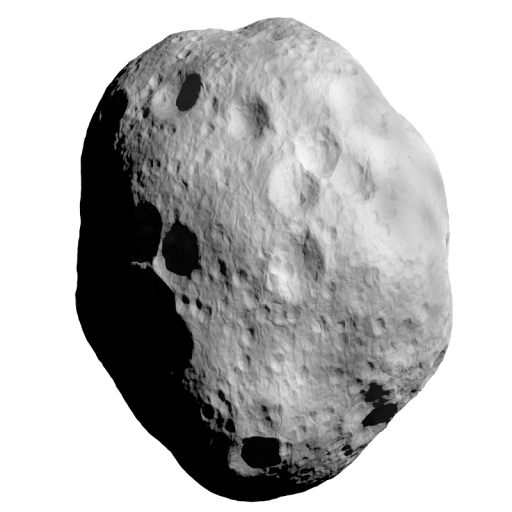
Key Facts
- Categorized as a Jupiter Trojan
- Comparable in size to the San Francisco Bay
- Not a Near Earth Object
- Not a Potentially Hazardous Object
- See orbit simulation
Overview
Euphemus is a mid-sized asteroid that shares Jupiter's orbit around the sun. NASA JPL has not classified Euphemus as potentially hazardous because its orbit does not bring it close to Earth.
Euphemus orbits the sun every 4,230 days (11.58 years), coming as close as 4.75 AU and reaching as far as 5.49 AU from the sun. Based on its brightness and the way it reflects light, Euphemus is probably between 5.352 to 11.969 kilometers in diameter, making it larger than 99% of asteroids, very roughly comparable in size to the San Francisco Bay.
No Close Approaches
Euphemus's orbit is 3.74 AU from Earth's orbit at its closest point. This means that there is an extremely wide berth between this asteroid and Earth at all times.
Orbital simulations conducted by NASA JPL's CNEOS do not show any close approaches to Earth.
Images and Observations
Euphemus's orbit is determined by observations dating back to Sept. 29, 2001. It was last officially observed on June 30, 2023. The IAU Minor Planet Center records 158 observations used to determine its orbit.
Accessibility and Exploration
This asteroid is not considered a viable target for human exploration by the NHATS study.Similar Objects
These objects have orbits that share similar characteristics to the orbit of Euphemus:References
Search
or view a random objectOrbital Elements
- Epoch: 2460200.5 JD
- Semi-major axis: 5.12 AU
- Eccentricity: 0.0723
- Inclination: 12.45°
- Longitude of Ascending Node: 306.77°
- Argument of Periapsis: 29.27°
- Mean Anomaly: 355.37°
Physical Characteristics
- Diameter: ~6.910 km
- Magnitude: 13.48
Derived Characteristics
- Orbit Period: 4,230 days (11.58 years)
- Avg. Orbit Speed: 13.17 km/s
- Aphelion Distance: 5.49 AU
- Perihelion Distance: 4.75 AU
Map Comparison
Orbit Simulation
Sky Map
The position of Euphemus is indicated by a ◯ pink circle. Note that the object may not be in your current field of view. Use the controls below to adjust position, location, and time.
Size Rendering
The above comparison is an artistic rendering that uses available data on the diameter of Euphemus to create an approximate landscape rendering with Mount Everest in the background. This approximation is built for full-resolution desktop browsers. Shape, color, and texture of asteroid are imagined.