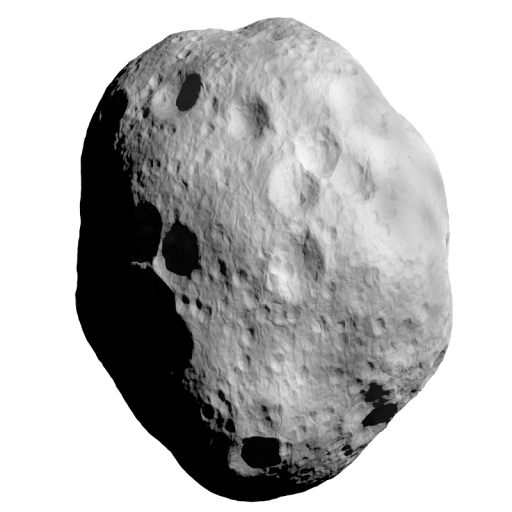
Key Facts
- Categorized as a Aten-class Asteroid
- Comparable in size to a school bus or smaller
- Will pass within 27,684,326 km of Earth in 2026
- Classified as a Near Earth Asteroid (NEA)
- Not a Potentially Hazardous Object
- See orbit simulation
Overview
2016 WU7 is a very small asteroid whose orbit could bring it in close proximity to Earth. NASA JPL has classified 2016 WU7 as a "Near Earth Asteroid" due to its orbit's proximity to Earth, but it is not considered potentially hazardous because computer simulations have not indicated any imminent likelihood of future collision.
2016 WU7 orbits the sun every 280 days (0.77 years), coming as close as 0.47 AU and reaching as far as 1.21 AU from the sun. Based on its brightness and the way it reflects light, 2016 WU7 is probably between 0.024 to 0.054 kilometers in diameter, making it a small to average asteroid, very roughly comparable in size to a school bus or smaller.
Close Approaches
2016 WU7's orbit is 0.01 AU from Earth's orbit at its closest point. This means that there is a wide berth between this asteroid and Earth at all times.
2016 WU7 has 17 close approaches predicted in the coming decades:
| Date | Distance from Earth (km) | Velocity (km/s) |
|---|---|---|
| Nov. 30, 2026 | 27,684,326 | 12.577 |
| Nov. 28, 2029 | 25,807,400 | 20.358 |
| Nov. 25, 2039 | 6,658,409 | 14.703 |
| Nov. 25, 2052 | 11,890,544 | 17.734 |
| Nov. 27, 2062 | 20,334,339 | 13.065 |
| Nov. 25, 2075 | 2,152,922 | 15.458 |
| Nov. 24, 2088 | 5,524,553 | 16.587 |
| Nov. 28, 2101 | 20,540,271 | 19.366 |
| Nov. 28, 2111 | 17,834,112 | 13.298 |
| Nov. 25, 2124 | 5,439,522 | 14.876 |
| Nov. 26, 2137 | 2,294,206 | 16.005 |
| Dec. 3, 2147 | 29,172,106 | 12.509 |
| Nov. 29, 2150 | 23,359,470 | 19.917 |
| Nov. 25, 2160 | 9,618,361 | 14.282 |
| Nov. 27, 2173 | 10,179,375 | 17.431 |
| Nov. 29, 2183 | 21,723,277 | 12.937 |
| Nov. 25, 2196 | 2,621,456 | 15.360 |
Images and Observations
2016 WU7's orbit is determined by observations dating back to Nov. 25, 2016. It was last officially observed on Dec. 6, 2016. The IAU Minor Planet Center records 65 observations used to determine its orbit.
Accessibility and Exploration
This asteroid is not considered a viable target for human exploration by the NHATS study.Similar Objects
These objects have orbits that share similar characteristics to the orbit of 2016 WU7:References
Search
or view a random objectOrbital Elements
- Epoch: 2460200.5 JD
- Semi-major axis: 0.8375 AU
- Eccentricity: 0.4417
- Inclination: 19.77°
- Longitude of Ascending Node: 243.59°
- Argument of Periapsis: 41.68°
- Mean Anomaly: 45.57°
Physical Characteristics
- Diameter: ~0.031 km
- Magnitude: 25.2
Derived Characteristics
- Orbit Period: 280 days (0.77 years)
- Avg. Orbit Speed: 32.54 km/s
- Aphelion Distance: 1.21 AU
- Perihelion Distance: 0.47 AU
Map Comparison
Orbit Simulation
Sky Map
The position of 2016 WU7 is indicated by a ◯ pink circle. Note that the object may not be in your current field of view. Use the controls below to adjust position, location, and time.
Size Rendering
The below comparison is an artistic rendering that uses available data on the diameter of 2016 WU7 to create an approximate landscape rendering with New York City in the background. This approximation is built for full-resolution desktop browsers. Shape, color, and texture of asteroid are imagined.