Key Facts
- Categorized as a Apollo-class Asteroid
- Comparable in size to a football field
- Will pass within 20,969,181 km of Earth in 2019
- Classified as a Near Earth Asteroid (NEA)
- Not a Potentially Hazardous Object
- See orbit simulation
Overview
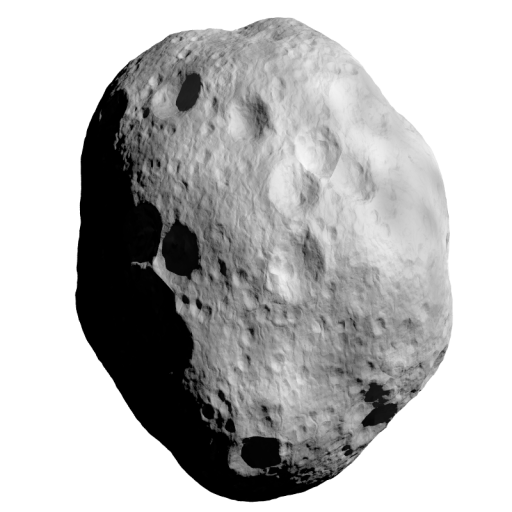
2002 EW is a very small asteroid whose orbit crosses the orbit of Earth. NASA JPL has classified 2002 EW as a "Near Earth Asteroid" due to its orbit's proximity to Earth, but it is not considered potentially hazardous because computer simulations have not indicated any imminent likelihood of future collision.
2002 EW orbits the sun every 714 days (1.95 years), coming as close as 0.33 AU and reaching as far as 2.79 AU from the sun. Its orbit is highly elliptical. Based on its brightness and the way it reflects light, 2002 EW is probably between 0.175 to 0.391 kilometers in diameter, making it a small to average asteroid, very roughly comparable in size to a football field.
Close Approaches
2002 EW's orbit is 0.07 AU from Earth's orbit at its closest point. This means that there is a wide berth between this asteroid and Earth at all times.
2002 EW has 13 close approaches predicted in the coming decades:
| Date | Distance from Earth (km) | Velocity (km/s) |
|---|---|---|
| July 4, 2019 | 20,969,181 | 24.591 |
| March 2, 2045 | 9,888,726 | 27.040 |
| July 4, 2062 | 22,026,196 | 24.188 |
| March 3, 2088 | 11,277,198 | 28.006 |
| July 9, 2105 | 29,695,999 | 22.157 |
| June 27, 2107 | 23,408,782 | 29.928 |
| March 9, 2131 | 20,081,952 | 30.429 |
| Feb. 25, 2133 | 24,839,094 | 22.276 |
| June 28, 2150 | 20,826,357 | 29.152 |
| March 9, 2174 | 19,118,843 | 30.227 |
| Feb. 25, 2176 | 27,559,413 | 21.708 |
| July 9, 2191 | 28,145,630 | 22.480 |
| June 27, 2193 | 25,136,404 | 30.501 |
Images and Observations
2002 EW's orbit is determined by observations dating back to March 5, 2002. It was last officially observed on March 9, 2006. The IAU Minor Planet Center records 111 observations used to determine its orbit.
Accessibility and Exploration
This asteroid is not considered a viable target for human exploration by the NHATS study.Similar Objects
These objects have orbits that share similar characteristics to the orbit of 2002 EW:References
Search
or view a random objectOrbital Elements
- Epoch: 2460200.5 JD
- Semi-major axis: 1.563 AU
- Eccentricity: 0.7879
- Inclination: 6.71°
- Longitude of Ascending Node: 15.77°
- Argument of Periapsis: 24.28°
- Mean Anomaly: 28.95°
Physical Characteristics
- Diameter: ~0.226 km
- Magnitude: 20.91
Derived Characteristics
- Orbit Period: 714 days (1.95 years)
- Avg. Orbit Speed: 23.82 km/s
- Aphelion Distance: 2.79 AU
- Perihelion Distance: 0.33 AU
Map Comparison
Orbit Simulation
Sky Map
The position of 2002 EW is indicated by a ◯ pink circle. Note that the object may not be in your current field of view. Use the controls below to adjust position, location, and time.
Size Rendering
The below comparison is an artistic rendering that uses available data on the diameter of 2002 EW to create an approximate landscape rendering with New York City in the background. This approximation is built for full-resolution desktop browsers. Shape, color, and texture of asteroid are imagined.